August 8th, 2025,
Those who know me intimately know that the Canticle of Canticles is my FAVORITE book in Holy Scripture. Me being obsessed? Understatement. In a recent group email I wrote the below in bold:
I am obsessed with finding saints or doctors of the Church who do verse for verse breakdowns. Several saints have also issued a warning to those who read the Canticles without a purified mind as many take that book and run with it saying it’s sexual. It’s not. It’s the story of union between Christ and His bride the Church, but above all, it first and foremost applies to Mary as the True Bride, as well (as Douay Rhiems states in their footnotes: it’s the Church AND Mary).
One of my favorite breakdowns of the “song” is Bernard of Clairveaux’s. I keep his enormous book of sermons on hand, on the Canticles, and The verse that kept coming to mind the last two days, which urged me to look up his sermon on the verse was: “My Beloved to me, and I to Him.” As usual, Bernard doesn’t disappoint. Like him, I was confused how the bride seems to be claiming an equal and mutual love with Our Lord. That’s impossible, right? IT’S GOD. We are the creature and He is the Creator. Look at his reasoning; it’s profound:
“The reason is that she wants to prove herself to be MORE FULL OF GRACE, assigning it both to the beginning and the end. For how could she be full of grace, if there is anything in her or belonging to her, which was not from grace in a soul already occupied by merit.”
Bernard later says that Our Lord’s CHOICE of the bride anticipated her merits, and thus… ALL IS GRACE. THERE IS NO ROOM FOR ANYTHING ELSE. Including personal merit. What does all this mean and what does it have to do with Mary? Mary is FULL OF GRACE, which means exactly that: FULL, and to the brim. Mary only asked us to do four specific things (outside of the sacraments) on a daily basis to receive this GRACE:
1.) wear Her scapular
2.) wear Her miraculous medal AROUND THE NECK. I read recently how Mary represents the NECK (tower of David) connecting Our Lord as HEAD to His BODY, the bride, His Church, and so it makes sense that Mary would want the medal of GRACE worn around the neck because if that supply of grace is always there, what fear does the bride have of ever being separated from Her beloved? Hits differently now, knowing what we do from Bernard, doesn’t it?
3.) pray Her rosary every day.
4.) pray Her seven sorrows rosary EVERY DAY.
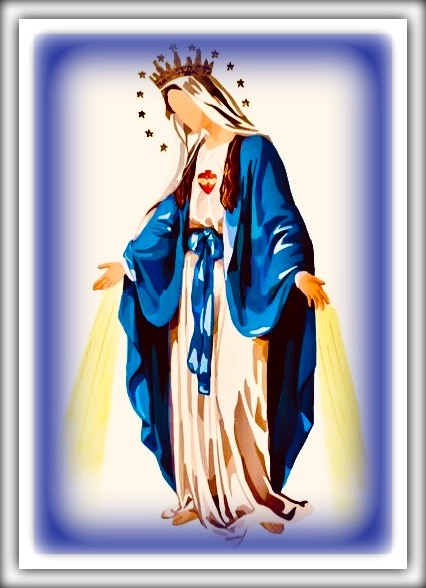
I mean… THAT’S IT. It’s not hard. And two of those can almost be considered “freebies” because all we have to do is wear them (medal and scapular). My reply to people who say they don’t have time or the scapular is “annoying” or “it’s not required to attain heaven” are two things: If you really love Mary as Mother, wouldn’t you want to do ALL She asks? I put love first and foremost because love makes all things easy. Second, I refer back to Bernard’s merit vs. grace argument. Many people today in the Church have this preconceived, and downright prideful notion, that they don’t need Mary. But I have news for you, NO GRACE comes to us from the Trinity without FIRST being distributed through Mary. Hence why we see HER HANDS outstretched as She is the distributor. The Most Blessed Trinity’s System of Grace:
1.) Through the Blessed Virgin Mary, passed down to,
2.) Holy Mother Church through her sacraments distributed through the Catholic Hierarchy of the priesthood. Whether anyone likes it or knows it, God has willed to distribute His grace this way.
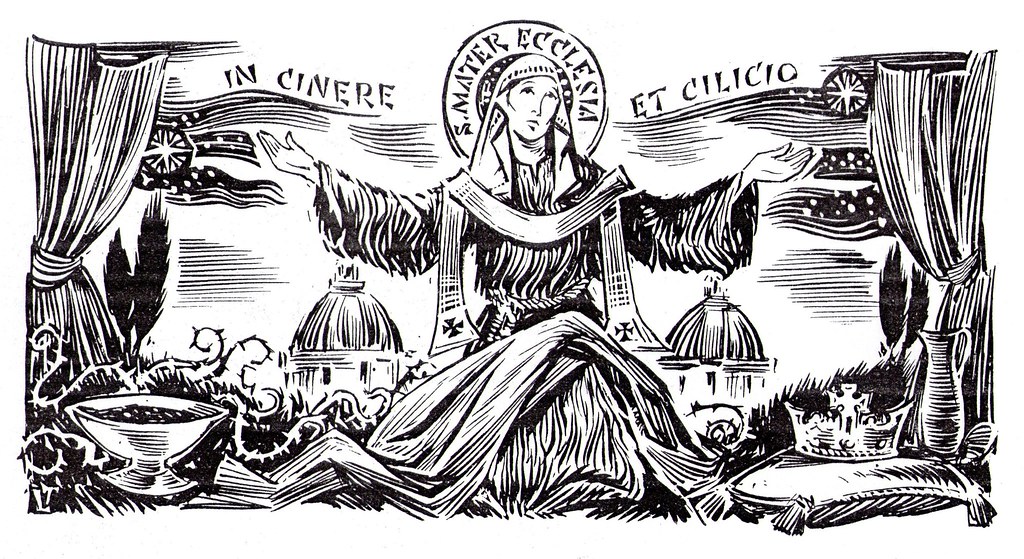
The number 5 is associated with grace and I kept pondering the “why” behind that, and it must have been Our Lady directly answering me, as I recall HER FIVE FINGERS on Her hands where these graces are distributed. And you know how I realized Satan hates this? Most satanic images are created with SIX fingers, including most AI images (proof artificial intelligence is not of God). I don’t think that is coincidence. It’s on purpose. This is a real war between Mary’s “seed” (the Church) and Satan and his “seed” (anti christ and company). Aflavia made a remarkable discovery recently when she shared my view of this also being her favorite book in the Bible, as well: she said that the Song of Songs is purposely in the MIDDLE of God’s entire story. Not only is this figurative but literal:
“I learned from a video that the Canticles is right in the center of Holy Scripture! The person said the Bible from beginning to end tells a story about Marriage and right in the very HEART of this Story is THE CANTICLES! I checked my Douay Rheims (I have Baronius Press edition) and it has 1,383 pages if I add both the Old & New testament together! I divided that by 2 and got 691 which is EXACTLY the page the Canticle begins!”
I have also heard how Our Lord began everything with a wedding (Adam and Eve) and it will end with a wedding (Our Lord and the Church). I also once read by an anonymous monk who wrote Hermitage Within how Our Lord “restores much more wondrously than He creates”. Let me give you some examples:
1.) NEW Adam (Our Lord)
2.) NEW Eve (Mary)
3.) NEW Jerusalem (Catholic Church)
Does not the very word Apocalypse mean to “UNVEIL”. The lifting of the WEDDING veil by Our Lord? This is not a stretch because the Canticles is all about the story of UNION between Our Lord, and His bride, the Catholic Church, and above all Mary as the true Bride (also being Mater Ecclesia to Ecclesia Romana). In the Song we read how Our Lord is utterly captivated by the bride’s eyes in particular, for they are “doves” since she now sees everything through the mature lens of grace and of the Holy Ghost. Holy Ghost eyes! Even through the veil He sees how she only has eyes for Him, and that’s all it takes for the King of kings to “lose His reason” (“a strand of hair on your neck” as John of the Cross writes, “was all it took”) and climb aboard the chariot to rush at all speed to meet her.
He had to choose the fastest approach. Even running was too slow for Him. How… romantic? In the Canticles we read about Our Lord racing on a chariot, and in the Apocalypse He is riding on a WHITE HORSE to meet His bride? IT DOES NOT GET MORE KINGLY, ROMANTIC OR GLORIOUS THAN THAT. The whole Canticles is nothing BUT romance (and despite all the plagues and anti christ in the Apocalypse, it ends with a wedding). But is not the Catholic Church ROMANce? The word romance has the word ROMAN in it. ROMAN CATHOLIC CHURCH. Aflavia and I joked how there is the heart eyes “😍” emoji and we created our own image of “dove eyes emojis” for Our Lord and it’s… the best, is it not?
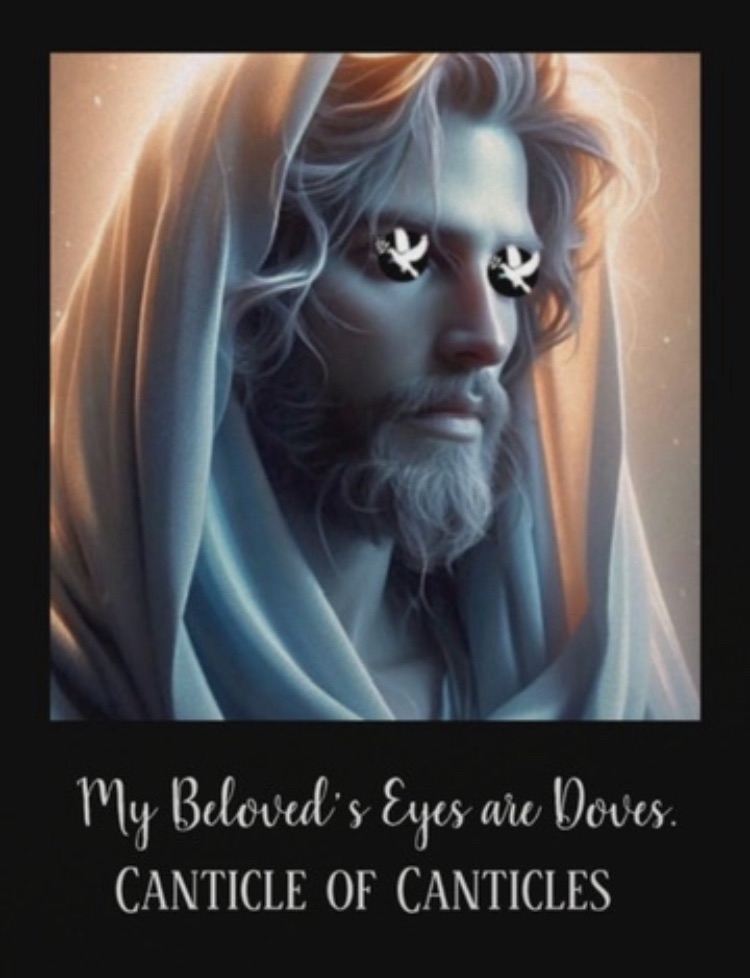
Instead of heart eyes, when we see something we like, we say “dove eyes”. I think Our Lord is impressed! Really though, imagine Him looking at you with love and His eyes turning to doves rather than hearts. I’m all in! Sign me way up! I said in the beginning how those who know me intimately know of my obsession with “the Song” 🎶, and I would also add that those who know me on a personal level also know that I love almost all things Jane Austen. One of my all time favorite posts on the subject can be found Here where I wrote how specifically Our Lord teaches the soul to fall in love with Him, and His favorite method of “whooing” said soul, and I shared examples through Jane Austen’s novels.
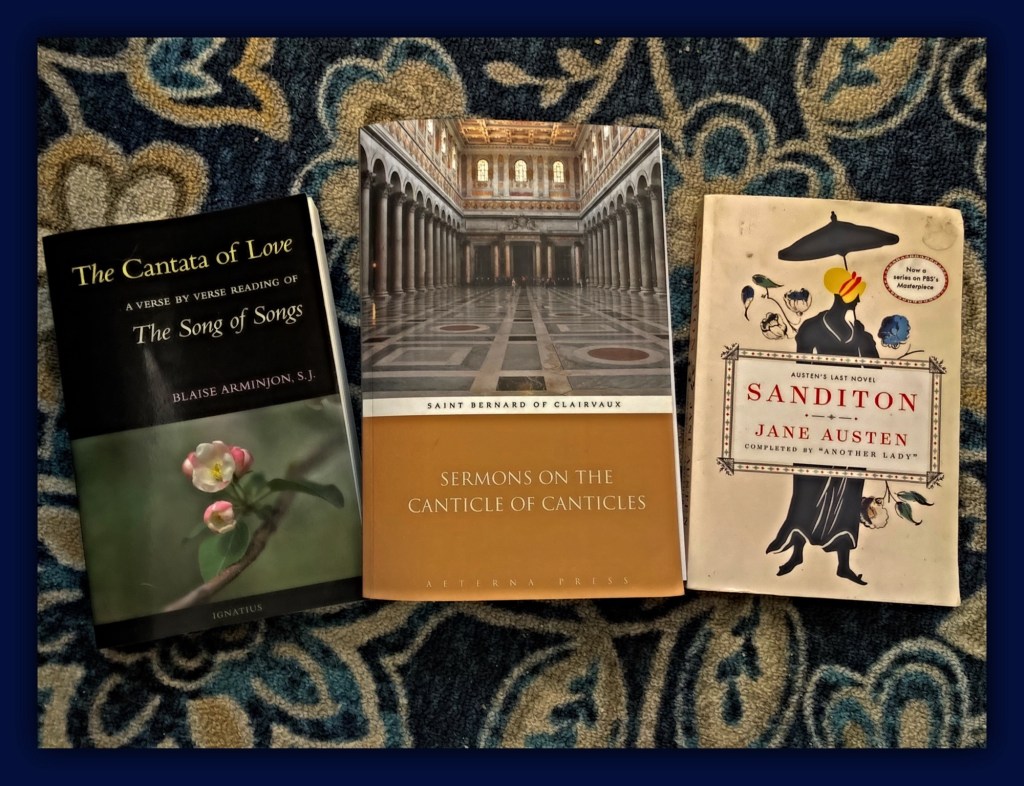
But today I want to compare a specific verse from “the Song” and compare it to my number one favorite Jane Austen story (Persuasion being my second favorite). Well, the book was started by Austen but she died before she could complete it and it was officially “finished” by an anonymous author who chose the co-author title of “another Lady” (Our Lady? Kidding, sort of 😏). The book is Sanditon. I have it pictured above with my other “go to” commentary books on the Canticles that I keep on hand by Bernard of Clairveaux’s verse for verse break down of the Song as well as the book Aflavia gifted me on the feast of the Holy Family this year, 2025, by Blaise Arminjon, S.J. (I know, I know, a Jesuit! Ruh roh!). But I can’t recommend this book enough; I’ve highlighted nearly every page (unapologetically).
The specific verse I want to draw (pun intended and you will understand in a moment) your attention to is “draw me”, said by the bride. Short and sweet, yet packed with meaning. In fact, Bernard spends several sermons on this one phrase alone. Mind you, I had already read Sanditon maybe three times by the time I had made the “draw me” discovery through Bernard, and somehow I did not notice this one utterly profound quote in the book spoken by the hero Sidney to the heroine Charlotte. Before I share it, however, I want to give a synopsis of the love story, so you understand just how pertinent the words are because this particular storyline really does remind me of Our Lord and His bride, the Church, and the love story of union paralleled in the Canticles.
Charlotte, our heroine, goes for an extended summer vacation on the seaside with a local family, who hosts her, named the Parkers. Charlotte is very level headed, filled with common sense and … it takes a lot to “whoo” her. Until Sidney Parker enters the scene. It does not take long for them to be “drawn” to one another, but she is determined to keep her wits about her and not be a love sick fool. In fact, she has so much good sense that she is at war with romance and you can see her wage this interior battle with two distinct things:
1.) She thinks Sidney is superior and so, has a hard time believing he would fall for someone like her (much like Our Lord being the superior to His bride… but “His choice of her anticipated her merits?”) so she tries to keep her distance so she does not get hurt in case her love is un-requited.
2.) She’s afraid of losing her will by falling in love with Sidney Parker.
Let me share a few quotes and scenes that back up these claims before I get to the cherry on top quote said by Sidney. Her “will” in this case is she has thus far seen romance as “unnecessary”. The subject was broached because they were talking of elopements and Charlotte in her common sense stated they were selfish things that often led families to worry. Such love clouds judgement and leads to rash behavior, to which Sidney asked her this:
“Will you make no allowance for the instinctive guidance of the heart, for intensity of emotions? Or do you consider they are also unnecessary? Oh, but your opinions fascinate me. They are so very definite that I long to know if they will change- or how and when they will change.”
In short, Sidney is determined to bend her will to his, and he is searching for a way…or rather, a weakness in Charlotte when it comes to love. Notice how he changes “if” to “how and when” they will change (showing his determination to win her). Not long following this conversation Sidney tricks her into admitting a jewelry box was not “unnecessary”, as remember, Charlotte is not the romantic sort, and the following scene happens and it is one of my all time favorites:
“You would not call it an -ah- unnecessary object?”
“Not at all, in this case,” she replied, biting her lip to refrain from laughing. She was willing to concede that Sidney had outwitted her; but she refused to look at him in open acknowledgement of the victory. She kept her own eyes very firmly on the box, determined to reserve her right to that measure of independence at least. But Sidney equally determined to impose his will on anyone with whom he chose to exert himself, continued to stand in front of her till in sudden embarrassment that everyone must be watching them – in a rush of confusion she was unable to control- Charlotte weakened and glanced up again. She had frequently found the teasing expression of Sidney’s eyes to be exasperating, and had every intension of meeting it with a blank look of innocent gravity. But before she could check herself, she discovered she was smiling back at him involuntarily and admitting that, exasperating or not, Sidney’s teasing gleam had become quite irresistible to her. In that moment, as they stood smiling at one another, Charlotte was conscience of several contradictory sensations, of which the chief were these: annoyance with herself for being incapable of governing her own actions, satisfaction that Sidney had won this very minor victory over her, amusement, embarrassment – an odd something between perturbation and pleasure – and above all else, a flutter of joyful spirits which made her feel she had strayed somehow into a most unfamiliar world. And as Sidney turned away, a phrase he had used that morning drummed suddenly in her ears: “will you make no allowance for the instinctive guidance of the heart?” Was this what he meant? Could such a thing happen to someone as sensible as herself? Could she have so little control over her own conduct that Sidney could make her behave according to his will and not hers?
Sidney ends up buying her the jewelry box secretly and surprising her with it the following morning, leaving it with his family along with a hastily written note, before leaving town for a trip, and Charlotte’s reaction reminds me of Bernard’s words of the Bridegroom’s “choice of the bride anticipated her merit”. For she could do nothing to earn His selection of her, for His choice of her is a mere gift on His part. Charlotte thus describes her emotions upon receiving the gift:
“A young lady’s exact estimate of her own charms would be a difficult matter to determine but Charlotte certainly never estimated hers as MERITING the full treatment of Sidney’s intricate little plots. If she could have brought herself to believe he had purchased the box especially for her… she would have valued the gift even more.”
Several things must be addressed in these two scenes that tie directly into scenes in the Canticles. The scene where Charlotte realizes that Sidney has become “irresistible” to her and how the “how and the when” he can bend his will to hers, was seen on full display in that encounter. And he knew it. In “the Song”, Our Lord is describing even His bride’s teeth. Blaise Arminjon in his Cantata of Love describes this scene and you tell me whether or not it does not remind you of Charlotte and Sidney’s encounter above of him refusing to leave her until she catches his eye:
“The sparkling white teeth. The Bride of the Song must be smiling very brightly for all her teeth are showing, and the Bridegroom, Who is also a Shepherd, and as we know, full of humor ( there is so much of it in the Bible), smiles, too.”
Sidney’s entire method of bending Charlotte’s will to his, or rather, teaching her to fall in love with him through romance (yes love can be taught, read my link blog post above with how Our Lord does this) is about a sort of union of understanding. Is not The Song the story of TRANSFORMING union? “Union of wills”, as we hear John of the Cross so famously write? There’s even a “dark night of the will.” I remember seeing that in a table of contents section in a book on John, in Carmel during a retreat, and I shuttered. Dark night OF THE WILL? Just when you thought “dark night of the spirit” wasn’t bad enough.
Bernard also relays how the “I to my Beloved, and my Beloved to me” means that Our Lord essentially says, “you attend to My will, and I attend to your salvation.” Sidney even tells Charlotte, “I direct. You observe.”Now that we are getting closer to the quote that ties into “draw me”, let us visit the final scene in the book (spoiler alert). After a series of “Jane Austen misunderstandings” which entail Charlotte finding it impossible that she is the real object of Sidney’s affections, she seeks to avoid him, to which he finally declares himself thus:
I have always had my heart set on finding the most sensible, prudent, level-headed wife in the world. But, on the other hand, it is very important to me that she possess one very particular flaw: she must have no sense whatsoever where I myself am concerned. She would only have to take one look at me– and no matter what her steadiness of mind- she would lose it in the space of seconds. She would be willing to elope with me– without another thought – the moment I asked her. This is the only way I can ever hope to be certain I have found exactly what I am looking for. If someone insists their feet are always firmly on the ground, how else can you discover if their head is sometimes in the clouds?
What we see so often in the Song is the bride languishing away in a sort of misery, which… leads her to sleep… a lot. Blaise Arminjon makes a comical comment about the bride being a “silly sleepy head” who must amuse Our Lord and the reader because one moment she’s very daring, full of energy and bold, and the next minute she’s sleeping. We know this because Our Lord even tells the daughters of Jerusalem three times to not “wake His love” until SHE pleases ( Song of Solomon 2:7, 3:5, 8:4).
This repetition emphasizes the importance of allowing love to unfold naturally and at its appropriate time, rather than trying to force or rush it prematurely. There is also a holiness to sleep. It signifies total surrender. Did not Our Lord SLEEP on the boat? That “boat” also represents the Catholic Church, His bride yet again, and as Our Lord’s place of “rest” or “dwelling” is in her (Jerusalem, Zion), it is only natural that we see Him resting on the “ark”. We now see her resting in HIM. The bride declares as well that though she sleeps, her heart is watching.
I once heard a priest say that the saints do more for God in sleep than those who rise to toil for reasons not centered on Christ. Sleep is also a symbol of death, which we know the bride must endure for the “veil” to be lifted for the marriage supper of the Lamb to begin. Even Therese reminded her sisters before her own death that she did not fear it because she said the catechism states that death is simply the separation of body and soul, so how could she fear a separation that would UNITE her forever to her God? That is also why she had a special devotion to the Holy Face. Through the veil, He watched her, waiting to lift it (death).
I do think there is an element to this sleep, however, that is for the bride’s humility. This goes back to the grace verses merit argument. In those moments of boldness, she must remember that she is only “filled with love” and GRACE that make her do extremely daring things for Our Lord she could never do with her own strength. This teaches her that she can do absolutely NOTHING without the King. What is equally profound is how Our Lord never ONCE criticizes her throughout the entire Canticle; in fact, the first time He goes to “sing” it’s to tell her immediately how beautiful she is.
Blaise S.J. remarks how Our Lord also doesn’t tell her HOW to do things either, because He knows full well she will throw herself entirely into His will, or not at all. For she is an all or nothing kind of soul. By the end, we see the same verses repeated of His praises, but they seem to be taking a higher octave of love as the climax of the song reaches its end goal of union; for the bride has become strong in grace (I will come back to grace). We are finally getting to that jaw dropping quote I opened this post with: following the above scene of Sidney’s declaration of love, Charlotte is beside herself not having truly believed that all along he did things solely for her:
“Surely my manner to you that day must have made my feelings plain enough? I told you – I distinctly remember it – that I had driven all the way from London only to dance with you, that I had missed you all week. It was you who made me pause in my madness and decide I was proceeding too quickly for you to keep pace with me.”
Does not that entire last sentence remind you of Our Lord as Bridegroom? We see my pink highlighted words of “madness” and “pace” because just as Therese indeed declared: Herod was right, Our Lord was mad… with LOVE. He chose to die a Lover’s death. The part where Charlotte is not able to keep pace with Sidney’s love, is EXACTLY the bride in the Song. Our Lord knows she WANTS to give her all, but the flesh is weak indeed. This is where “draw me” comes in! This is the bride’s little secret she even shares with her daughters, to which Therese takes up as well when she cries,
“Since we see the way LET US RUN TOGETHER.”
Bernard relays that “draw me” means that since the bride can’t keep pace with her Beloved by herself, she must DRAW directly from His grace (that’s where her boldness, energy and even “madness” comes from). And as I opened with, where does this grace come THROUGH always and only? Bells should be going off right now, ding ding ding! MARY. If She is “full of grace”, we must become “full of Mary”. As we saw with Charlotte, her “weakness” was Sidney himself. For us, our “weakness” must be Our Lord smothered in Mary. Where, like Charlotte, Jesus and Mary become so utterly irresistible to us that “in the space of seconds” we lose our “reason” and run after Them, just as Therese shared. We indeed see the way, and we the Church Militant must RUN into the arms of grace.
I read recently how love (romance) releases dopamine, often called the “reward” hormone, in the brain’s reward system, creating feelings of pleasure and motivation. This surge of dopamine contributes to the euphoria and excitement associated with the early stages of love, and can even create addictive-like behaviors. Does not this sound exactly like the bride one moment looking like a “love sick fool” (as we also saw Charlotte experience when LOOKING at Sidney) and also the bride’s “motivation” to run to meet Our Lord. You know what also produces dopamine? SINGING. The Song is two things: a LOVE story and a SONG. It is the Canticle of Canticles after all, and it is indeed a love song. We also see the bride displaying “addictive like behaviors” as she experiences this love song to the point where one minute she is running and the next minute she is sleeping.
A loving gaze can also trigger the release of dopamine in the brain. When someone sees a person they love, or even just a picture of that person, the brain’s reward system is activated (why I love holy images and also why the 4th Sorrow of Mary is one of my favorites). The look of love is Our Lord’s favorite “love language”. How do I know this? Easy, He imprinted His features, this “look” on Veronica’s veil, and left it as a gift to the Church. In fact, the promises in the Holy Face chaplet is for the Church to defeat her enemies through His five SENSES.
Why Our Lord uses romance and songs (senses- that harmony that the senses and the will had before the fall), even in the form of grace, to get the bride to achieve the most radical gifts of love to offer Him is because it allows her to “finish her course” and “fight the good fight” (passion) which leads to the wedding (resurrection). The wedding that has been predestined since, you know, before time (that easy to understand concept). Padreperegrino blog recently wrote two profound posts about Our Lord as Bridegroom:
“Under a Greek altar[in Jerusalem], one can put one’s fist into a hole going to the rocks split asunder and also where tradition tells us the Cross was placed during the crucifixion of the Son of God. Of all the icons that could have been used directly above the hole into the ground of Calvary’s cross, they chose “Christ the Bridegroom.” See the word in Greek, “O Nymphios,” meaning The Bridegroom.”
and
In fact, we know from Our Lady of Fatima that (like St. John the Baptist’s plight) the final battle against the antichrist “will be over marriage and family.” (Notice She didn’t say liturgy) Christ died for her to give her the Faith that no man can change.
and
So, if Mary refrained from both rebellion against the crucifixion and denial of the crucifixion of the Bridegroom, why are we so tempted to both of those against the Bride? Clearly, the only thing worse than the crucifixion of the Bride was the crucifixion of the Bridegroom. Yet we carry something similar in these final days. When we finally see Fatima’s promise of Triumph (be it the end of the world or be it the total restoration of the Catholic Church) it will redeem and outdo this current Church crisis, just as the Resurrection overcame and completed the Passion. Remember the first apostles to experience the Triumph of the Immaculate Heart of Mary will be the very Apostles who refrained from denying the current crucifixion of the Catholic Church.
Indeed, the “wedding” is death (the passion) and yet… many in the Church today want to just gloss and skip over that part and go straight to the resurrection. What I want to add to Father’s thought provoking statement of Our Lady not even having the Mass as the “final attack”, is that the marriage supper of the Lamb IS THE MASS (the sacrifice). I would say that this is EXACTLY why the true Mass of the Apostles is under attack right BEFORE the triumph of Mary’s Heart. Think about it: marriage… MARYage… AGE of Mary.
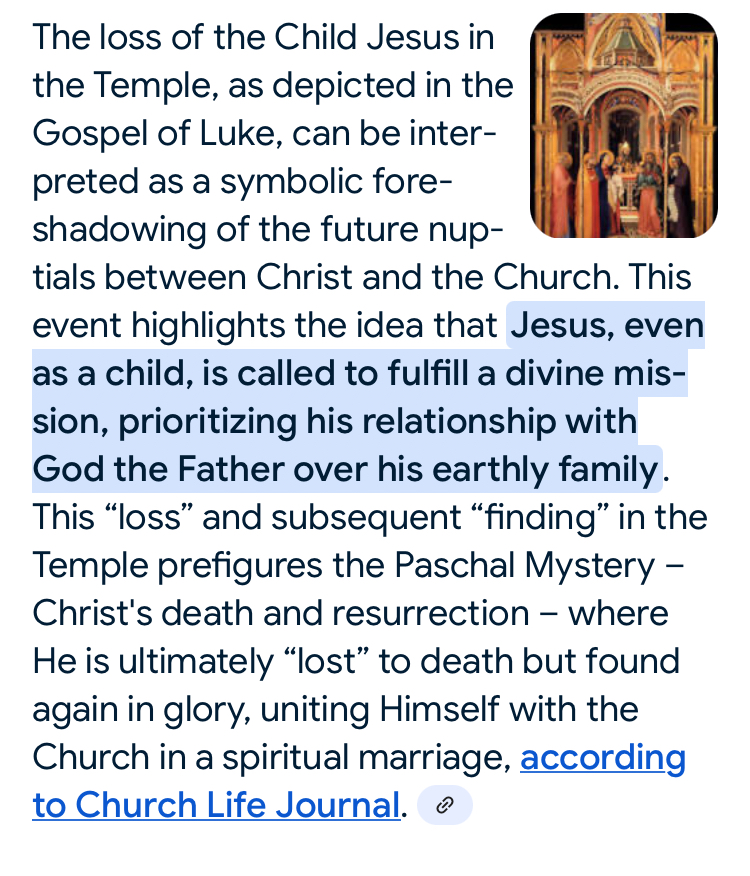
Mary’s triumph, and only the triumph of Her Heart, will lead to the wedding, because the bride, the Church, draws all her own victory of “union” from this tender Mother IN LAW. I remember once reading a book on Saint Joseph that declared Our Lord’s loss (and finding) for three days in the Jerusalem Temple was a “mysterious nuptials” between Our Lord and His bride, where Our Lord left Father and Mother and cleaved to His wife. I decided to do some more digging:
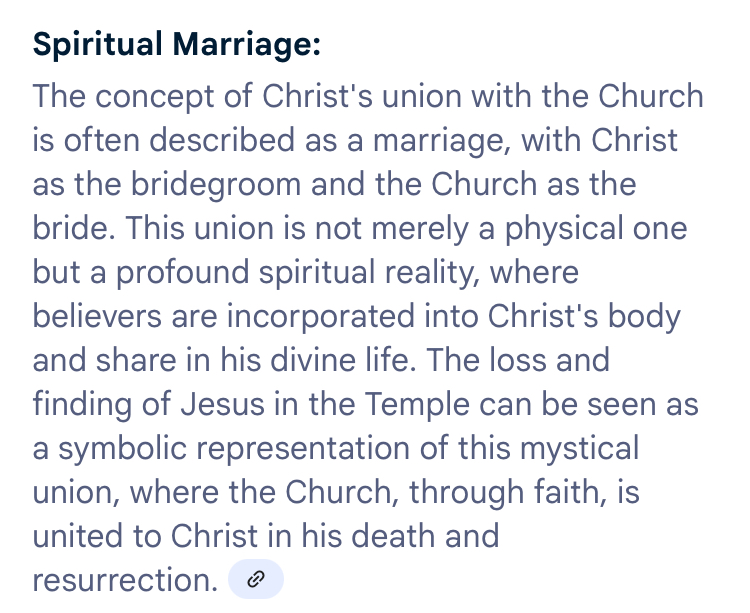
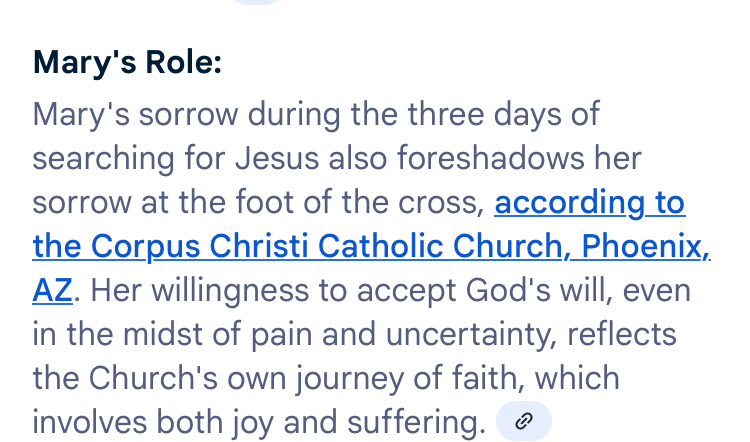
Everything just keeps coming back to the Marriage Supper, doesn’t it? To bring this lengthy post home, we truly see how “it was in the beginning” and “is now” (DAILY Mass and the Canticles being in the middle of the Bible) and “forever” a wedding between Our Lord as Bridegroom and “the bride, the wife of the Lamb” ALL officiated by Mary, as we saw Her divine role at Cana. In the exorcism prayer to Saint Michael we even read:
“He Who has built His Church on the firm rock and declared that the gates of hell shall not prevail against Her, because He dwells with Her all days, even to the consummation of the world” (Matt. 28.20).
I have said this before and I will say it again: I believe the Triumph of the Immaculate Heart of Mary is linked to the title of “Mediatrix of all Grace” being made a Dogma. The triumph of Mary’s Heart is the direct link to the predestined Marriage. I was given a book back in June by a fellow Latin Mass parishioner, a dear friend, and it was about the life of Mary as seen by mystics Anne Emmerich, Mary Agreda and Bridget of Sweden, and I was so moved when I read that when Our Lady was called home to the Heavenly Jerusalem, when She was called to leave Her place of burial near the Garden of Gethsemane, the angels began SINGING THE CANTICLE OF CANTICLES TO MARY: arise My Love, My Dove!
Can you imagine this moment for Her? She is indeed truly blessed among all women; Heart of my heart. So, if people are wondering why I am so obsessed with the Canticles, there you have it. I truly believe it is one of the greatest gifts Our Lord has ever bequeathed the Church, because if this specific love song will give us the grace and motivation to endure the upcoming passion of Holy Mother Church, this should be ALL OF THE CHURCH MILITANT’S go to book. Since we see the way, let us indeed run together, and let us run after Mary and the odor of Her ointments (grace).
 Carmelite Sister Martyrs