Feast of the Exaltation of the Holy Cross, 2025
(Part One of Three: Saint Paul Series)
The heart of Paul is the Heart of Christ.
~Saint John Chrysostom~

Before dropping out of college to choose the path of “bride of Christ” I bought into the feminist lie that women needed a fancy degree, need to do “all that men can do” (eye roll, I know: driving, working and doing all sorts of masculine things). I promise this will all tie into St. Paul, the “gentile prince” of the apostles by the end. However, I was also so exceedingly obsessed with the Church’s sacrament of marriage that I found it hard to believe that celibacy and chastity found in the priesthood or religious life were deemed as “the higher calling”. Ask any of my friends at my local Catholic College Parish at the time: it was all about marriage for me. And… it still is… but I understand, now, that the “banquet” I was destined to set my sights on was not one that ends at death, but rather officially begins with death (and never ends) with the Apocalypse’s version of the “lifting of the (wedding) veil.” Our Lord really does have a sense of humor. I once heard that the holy things, or even certain saints, we are destined for, and love, we tend to have a kind of aversion to and a period of “dark night” towards, in the beginning. I have experienced this toward religious life, The Sacred Heart, Saint Therese… and I have experienced this with Saint Paul.
Fitting, as Saint Paul had this very same “aversion” to Our Lord pre conversion, and he had it toward His bride, the Church. Does not this prove my point about the very holy things we are destined to work with, and love, we have to endure a strange period of purification of “intense dislike” to something we are set aside or reserved for, even when holy? Paul was “set aside” and “reserved” to be the “Best Man” to the very Church he persecuted (present at the martyrdom of Stephen), and to present her as a “chaste virgin” to the very God Man he once despised. This is all indeed… very mysterious, and only proves that the wisdom of men is indeed foolishness to God (PAUL Corinthians 1:20-25). Remember, the then Saul was so distrusted among the early Church that Barnabas had to essentially represent him and be his spokesman so as to ease the fears of the early Catholics who found it hard to believe that the very one leading the charge to bound them in chains was “all in” and “all the sudden”. Paul’s miraculous conversion was so instantaneous that this meme basically sums it up:
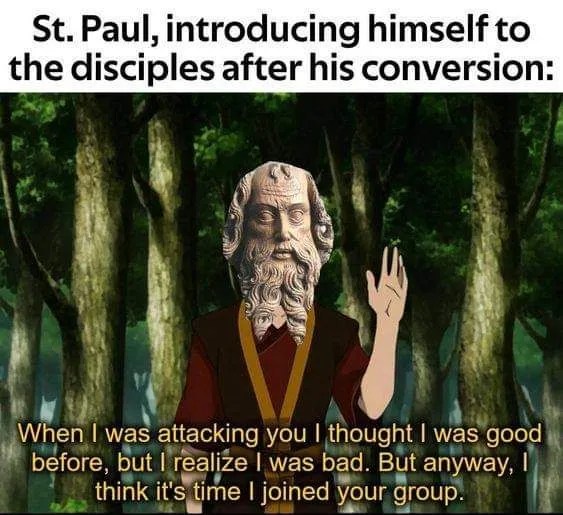
Those like Paul are “all or nothing” kind of souls and to those who don’t understand temperaments like this, just won’t get it (I laugh because I can more than relate as when I first dropped out of school, on the Exaltation of the Cross feast, to choose religious life, many Catholics who so knew of my “ardent” views prior, for marriage, did not take me seriously when I “instantaneously” chose “the better portion” I once scoffed at with vicious contempt). Sound familiar? Paul likely had the Choleric Temperament and TAN Direction does a far superior job than I at explaining why Paul’s temperament was both his weakness, and strength:
Our Lord’s personal encounter with this vigorous, hard-riding, bull-headed Roman citizen is a beautiful part of Church history. As Saul rode at a full gallop in the direction he thought was right, he was thrown from his horse and blinded by a flash of light. Our Lord spoke to him: “Saul, Saul, why persecutest thou Me?” (Acts 9:4). The direct approach was the only one that would work with this Choleric, and Our Lord knew that, of course.
“The direct approach was the only one that would work” and “full gallop in the direction he THOUGHT was right.” It’s so Paul, and it’s so utterly relatable. Let me say this from the getgo: I LOVE ALL THE APOSTLES AND PROPHETS. I have a deep devotion to Peter (the very “rock” I call the Catholic Church’s “wedding ring”), to Andrew (I entered Carmel on his feast), to James, to John and as far as prophets, to John the Baptist, Elijah and Henoch. It was Moses who first converted me in 6th grade through the scene of the burning bush that left me weeping tears of transformation and it was the story of Old Testament Joseph that taught me “trustful surrender to divine Providence” when he was sold and betrayed by his own kin. But something about Paul has often made me pause in a different way. When I have imagined what Apostle I would be most enthusiastic to see at death, it’s been Paul.
Something about him is “set apart”, “reserved”, “consecrated” and I have half serious, half jokingly called him “Best Man” to the Church, after a prayer I began saying some time in January, but it was only AFTER The Priest As The Best Man to Christ Post did I stop dead in my tracks when I found biblical proof that Saint Paul is indeed the Best Man to Our Lord’s bride, the One, Holy, Catholic and Apostolic Church. It was no longer just a “cute” nickname I liked to call him, it became real. It’s Paul’s “office” just as Peter’s “office” is the papacy. I found this incredible quote in the Saint Andrew’s Missal about the DISTINCT role of the Baptist:
As with the Jews, a FRIEND was the intermediary between the bride and
the spouse and prepared the wedding feast. Saint John is called “the
friend of the Spouse”. It is he God has chosen to prepare for the Lord, by
his preaching and baptism of penance a perfect people. And after having adorned the bride he presents the Spouse to her.

Father Pilgrim blog took those words and did some research on how the priest serves as Our Lord’s “Best Man” during the Mass rather than truly acting as “persona bridegroom” (is that a word?) because that role alone belongs to Christ (as Saint Paul even says, “ONE Husband”) just as there is only ONE Church. Bernard of Clairvaux in his sermons on the Canticles even talks about who the “watchman” are to the bride: the angels, saints, the apostles and prophets, who, day and night guard the walls of Jerusalem and “strengthen the bolts of her gates” (this is used for the Solemnity of Saint Joseph in the 3rd Wednesday after Easter Mass propers, which backs up the claim as he is the “watchman” and Guardian of the Church). Now, back to “aversion”. Another part of this “dark night” is simply known as “kicking against the goad” toward the thing we are “marked” for, and yet… it’s the very thing we want nothing to do with in the beginning. We often “persecute” the call, and even are filled with dread and fear at the thought of it (sound like Paul?).
It is almost comical. Kicking against the goad in ranching terms: when the shepherd is herding his flock, he will use a stick to keep the sheep moving forward (sometimes even prodding into the skin depending on how much we fight back). No matter how much the sheep may buck the shepherd, they have no choice but to move forward. For example, you know when a lamb wanders off away from the herd and we see that classic photo of Our Lord carrying it back? Blogger Ann Barnhardt sums it up well in her below explanation, and it’s, well, not exactly as glorious as it looks from the art we usually see (trust me, whenever you see the image of Our Lord holding the lamb, from now on, you will often think of this below description, after reading what really happens). My former Carmelite Confessor joked with me how art is often so dramatized to look all glorious and exxagerated, and he used Mary’s 2nd Sorrow of the Flight into Egypt as an example of some artwork showing The Holy Family leisurely eating grapes on their journey, as if the 200+ miles was a piece of cake. Yeah, not at all realistic. Barnhardt describes the Divine Shepherd carrying the lamb thus:
When a shepherd would go out and search for a lost sheep that had
wandered off, when he found the lost lamb, he would BREAK OR
DISLOCATE ITS LEG, and then carry it back to the flock on his shoulders.
This husbandry technique is called “hobbling.” We have all seen that
image of Our Lord as The Good Shepherd. He wasn’t carrying the lamb
because it was fun. A shepherd would be carrying the lamb because he
had intentionally crippled it. Why? Why break or dislocate the animal’s
leg? First, to keep it from wandering off again. Second, in order to train it to
stay with the flock. While the leg was mending, the lamb would NOT
wander off and learned to stay with the fold. This was done not just to
protect the straying lamb, but also to protect the rest of the flock. Sheep
are very gregarious. If one is heady and heads off on some tangent, the rest
of the flock might go after it instead of staying with the shepherd.
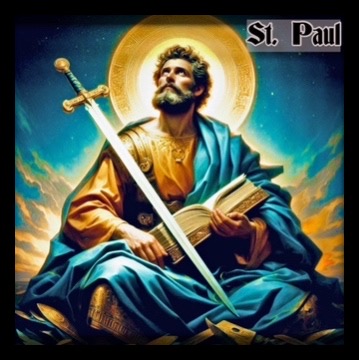
Again, next time you see a photo of Our Lord holding a lamb, remind yourself that it likely has a broken leg. But apply the above “hobbling” technique to Saint Paul! Was not he “knocked off” his horse? Were not his EYES “crippled” for a time? I once heard Father Phil Wolfe in a sermon on Fatima say, “when the best are not the best [BEST man?], they become the worst.” He applied this to Saint Paul, and he applied this to Russia. What do they share in common? PREDESTINED CONVERSION THROUGH MARY. They are both chosen by Mary for consecration and have a specific task. I will come back to that, but first I will again apply Paul’s temperament to my above argument about the best being the worst:
“Deep and passionate temperaments which either are not trained or are left to themselves,” wrote Father Joseph Massmann, “rage like torrents and leave in their path a sort of devastation.” Instead of sweeping through life leaving destruction behind them, Cholerics must learn self-control and use their leadership tendencies to blaze a trail of virtue and lead the charge to Heaven.
This is why temperaments like this are BEST left in the hands of Mary through consecration to Her. We have indeed seen the above behavior with Paul and Russia. We have also seen this with the Jews. When “left to themselves” they leave a trail of destruction. The excerpt below taken from Saints to Remember by The Slaves of the Immaculate Heart of Mary has this to say about Saint Paul’s vehement devotion to the Madonna:
Saint Paul, after his conversion, became very devoted to the Blessed Virgin Mary, the Mother of God. He would not let his name be connected to Hers overtly because of the way he had persecuted Christians before his conversion. But in the midst of all his journeys, he was constantly returning to Jerusalem to see Her. It was Our Lady who caused Saint Paul’s name to be put immediately after Saint Peter’s in all the Litanies where the Apostles are mentioned. It was Saint Paul’s disciple Luke – a Gentile- who wrote the third Gospel, which is properly called “the Gospel of Our Lady”. Saint Paul wrote fourteen Epistles in the New Testament. One can see from these simple leads how devoted Saint Paul was to the Mother of God. As soon as Saint Paul converted Denis the Areopagite in Athens, he brought him to Jerusalem to see Mary. Saint Denis said that if he had not been stopped from doing so, he would have fallen on his face before Mary and adored Her as God, so radiant was Her holiness and so transcendent was Her beauty.

Finally, the sheep submit, rather than continue fighting against the goad, and give in, because there comes a point where they realize… it’s futile to fight something that WILL HAPPEN (predestined conversion). The more they fight, the more exhausted they will become. This applies to no one better than Paul, doesn’t it? My former Carmelite confessor also once told me the powerful words of Blessed John Duns Scotus of, “sometimes a soul’s mission is so important in the Church that God will find even a back door to make said soul give in.” Doesn’t that apply to Paul? He clearly did not have a choice; why Our Lord said, “it is hard for you”(🙄).
Convert means to change, and that “change” can only be done through consecration to Mary.
We see this “change” happen at Mass; consecration is indeed a miracle. Again, apply this to Paul. I have often said, even before reading the above post on the “Best Man”, that Saint Paul is “Best Man” of the Church. As I said, I kind of said it jokingly since January of this year or before that, but the more I pondered it, the more the evidence fell in my lap. Think about it! What did that quote above say about John the Baptist? He presents Our Lord to the BRIDE. But what does Saint Paul do? We have his own words:
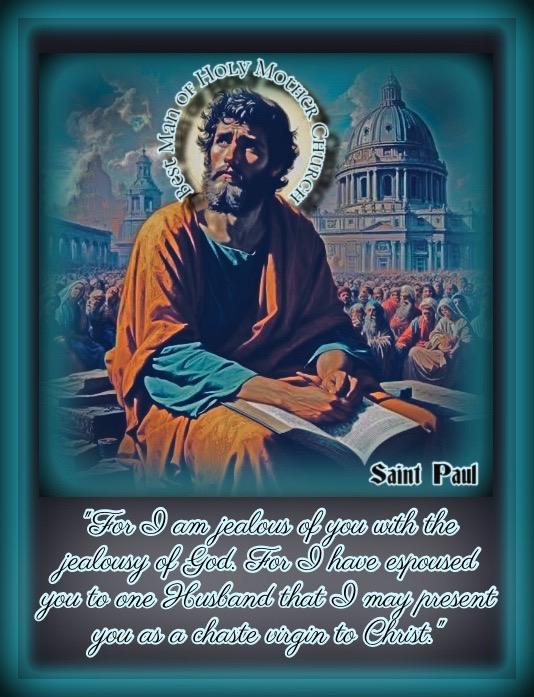
“I HAVE ESPOUSED YOU TO ONE HUSBAND. THAT I MAY PRESENT YOU AS A CHASTE VIRGIN TO CHRIST.”
2 Cor 11:2
Saint Paul presents THE BRIDE to the Bridegroom! John presents the Bridegroom to the bride. I wish someone could paint this image of Saint Paul presenting the bride and Saint John the Baptist presenting Our Lord, but I’m not an artist and I’m also picky with art. Don’t even get me started on the so called “art” that is Byzantine. But, where was I? I’m starting to sound like Teresa of Avila losing her train of thought in the middle of a sentence. Heaven forbid!
This 2025, on the lead up to Mary’s Assumption, I was given a pile of books by a very kind parishioner friend of mine and one of them was called The Life of Our Lady as Seen by the Mystics. I skipped to the end (something i’ve had a horrible habit of doing since my youth, but in this instance it paid off) to the final three chapters of Our Lady’s death, “dormition sleep” and Assumption. Tradition shows Mary died on August 13th and assumed into Heaven Body and Soul on the 15th so as to perfectly mirror the three days of Her Son. This is traditionally called Mary’s Triduum (special Matins are traditionally said starting on the 13th and festivities begin on the eve of the 12th likely with Vespers) and is not widely known but these three days are exceedingly sacred and should be treated with great love and reverence:
August 13th symbol of Mary: palm of martyrdom.
August 14th symbol of Mary: cross of Her burial and sleep.
August 15th symbol of Mary: golden rose of Her triumph.

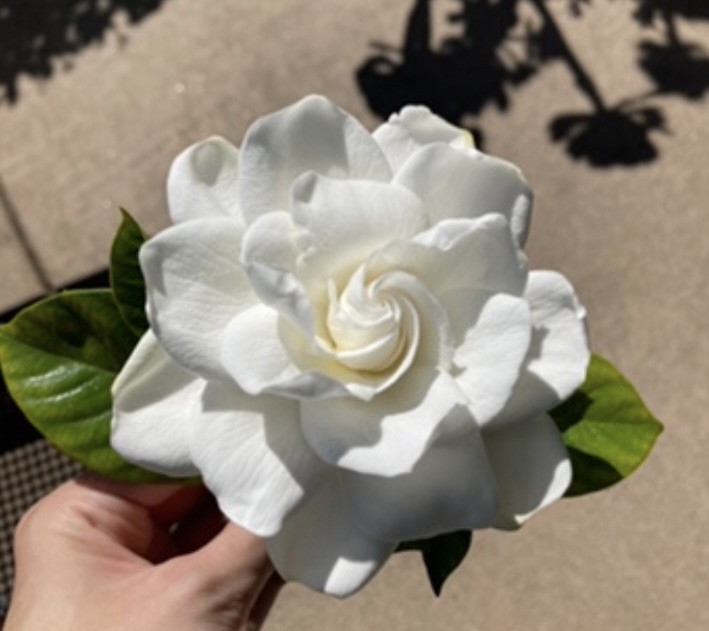
I was sitting in a garden area near the Chapel after Mass upon receiving this book, smelling the most glorious scented white rose I have ever smelled called a Gardenia that just happened to be in full bloom nearby (they only come in white apparently) just reading the final chapters of Mary’s earthly sojourn, weeping like a baby; I couldn’t even see the pages at one point as my eyes were so blurred (two things often make me cry: Mary and the death of the martyrs). The scent of that Gardenia was like a foretaste of the scent of Mary as I read the final stages of Her heroic life: “the odor of Her ointment”. Not only did I read that Saint Gabriel appeared to Mary THREE YEARS in advance to predict the very day She would leave the earthly Jerusalem for the heavenly Jerusalem, but that even though She wanted nothing but to be with Her Divine Son, She never asked Him to take Her to heaven because She was THAT humble and selfless (here I am practically begging God on a daily basis to take me out of this depressing valley of despair).
She spent those final three years giving HER ALL to the Church Militant and the apostles in the most selfless way that left me in stunned amazement. Her virtue was indeed an “odor” of divine perfume that is a mere glimpse into Her soul. She favored James the Great as Her favorite apostle, and what moved me greatly was reading about the devastation of the apostles when they knew that Mary was to leave them. Especially John. As he was preparing Her burial near or in the Garden of Gethsemane, he was exceedingly downcast. I could feel the sorrow through the pages. I felt like I was truly there; it was heart wrenching. I caught a glimpse of those final days and while I was excited for Mary to leave this wretched world to finally be with Her “Beloved”, I was devastated for the apostles and the Church Militant. She became so much “Mother of the Church” after the Ascension of Her Son, that to have lived during those times and suffer the loss of Mary, seemed unbearable. It actually made me thankful I didn’t live in those times, because how could one live without Mary? This is where I read how all the apostles BUT PAUL, were summoned to Her burial and Assumption (Andrew might not have been there but I can’t recall why). Me being confused at Paul not receiving “an invite” confused me. That’s an understatement, actually. It bothered me… because, you know, it’s Saint Paul! It’s so smothered in mystery, is it not?
But this is the thought that seemed to strike like lightning. The other apostles seem to be “Best Man” to Our Lord, but Saint Paul seems to be entirely “singled” out with the specific task of being “Best Man” to the bride alone, and that wedding is still to come. I have this sense that not even the other apostles get this unique “office”. But it makes sense when you deeply ponder it. Saint Paul was destined to preach to the gentiles. When Our Lord was rejected by His own, the Jews, He took residence with the gentiles (the Catholic Church is known as the Gentile Church)… the Gentile bride? The other apostles were formed under the tutelage of Our Lord and as we read, He occasionally separated John, James and Peter.

Not so Paul. Paul was formed by Christ and Christ alone (as we read after His conversion he entered into the wilderness of Arabia to receive direct formation BY THE RESURRECTED CHRIST). Was Paul chosen to replace Judas? No. Another “Best Man” of Our Lord was chosen in the place of Matthew. Paul was chosen separate from the 12 and AFTER the BIRTH of the Bride (the Church) to begin his “office” as her mentor and intermediary. Remember, it was none other than Our Lady who made Saint Paul equal to Peter by elevating him as
prince of the apostles! We often hear him called “the 13th apostle”, but he’s not really even that at all. He’s been made equal to Peter as my favorite above meme shows (why whenever we celebrate Peter we commemorate Paul and why when we celebrate Paul we commemorate Peter). Though two separate “offices”(that of “rock” and “Best Man”, they both shed their blood ON THE SAME DAY to give the faith to the Church).
If the marriage supper of the Lamb is reserved for “the end” with the triumph of Mary’s Heart and the “conversion of Russia”, and even the conversion of the Jews is likened to Saint Paul’s conversion, I think his part is reserved for the wedding in a special way. The Church is Mary’s “portion” and “dowry” and this wedding is being planned as we speak. If he wasn’t summoned to Mary’s Assumption, perhaps that is because he is being “held back” to be summoned for Mary’s triumph. We have one more “passion” to endure, per the catechism. And that’s the passion of Christ’s bride, the Church, to which this bride can only conquer this death, through the triumph of Mary’s Heart. The two are not to be separated. Paul, again, confirms his OFFICE as Best Man in the PASSION OF THE CHURCH:
“Who now rejoice in my sufferings for you, and fill up those things that are wanting of the sufferings of Christ, in my flesh, for his body, which is the Church.”
Col 1:24
Can it get anymore clear? We have Paul’s own testimony in his epistles (HIS 14 LETTERS TO THE BRIDE, THE CHURCH DIRECTING HER STEPS), confirming his role as “friend”, “intermediary” and “BEST man.” One of my favorite songs with the most haunting lyrics is called “I Save the Best for Last” by my all time favorite artist CHPTRS:

Mary’s triumph is the crushing of the serpent and it’s “saved for last” (IN THE END MY IMMACULATE HEART WILL TRIUMPH) and Saint Paul is indeed “the best”. Not to be biased, but it’s true (though I certainly am biased to be sure); Saint Paul is consecrated and set apart. I looked up what the role of a best man entails and applied it to the Church and it’s powerful:
Right hand man on the wedding day and on the lead up to it.
He is the “right hand man ON THE WEDDING DAY” to the bride, the Church, and “on the lead up to it.” Doesn’t it feel like we are in the home stretch? Mary said the consecration of Russia would be late, but it would happen. That’s a promise. Peter gave the Church his faith, but I like to think Paul gave the Church his “will of iron”. The author who wrote Hermitage Within, an anonymous monk, said that Saint Paul loved Our Lord with an almost savage type love, and the reason I love that, is his love truly stands out above the rest of the apostles. Even his writing style is unique and can be recognized almost instantly by those who are his ardent devotees. He’s a real “man’s man”. A man after the Sacred Heart. It’s consecrated. Saint Paul is for the Church what John is to Mary. Saint Paul, like John, was also unmarried. This is noteworthy and I think providential!
But also this: Saint Paul is reserved for BOTH Mary and the Church, since both are Brides and both share this “triumph”. Why else was Paul often returning to see Mary? Mary’s portion, the “elect”, is the Church and thus, Mary and the Church belong entirely to one another as “dowry”. Mary to the Church and the Church to Mary ( likened to “my Beloved to me and I to Him”). How glorious! WE are the Church and thus, we are Mary’s absolute and total property. Just as John the Baptist kept straight the paths to prepare the way of the Bridegroom, so too does Paul do exactly that, for the bride. Let’s put it this way: the Immaculate Heart of Mary will triumph THROUGH the Catholic Church, restoring the bride’s Liturgy, Papacy and Holy Land (those things have been totally highjacked) and Saint Paul will be there to make sure the bride “endures sound doctrine” as well as “endures to the end” (final passion).
That very same friend, who gave me the book on Our Lady, also provided another miracle for me to confirm these “Saint Paul revelations.” And it indeed was a miraculous confirmation. He sent me some emails of links to scroll through and for the first time I notice his profile photo looks like Saint Paul, and I was very excited to know if it was. I HAD to know with all the stuff already going on with Paul. He told me it was a photo of a cactus, to which I told him, “your photo is certainly not a cactus.” I sent him a photo of what I see on my end, and he marveled at the fact that his picture on my end is Saint Paul and on his end it’s indeed a cactus. What the? He said out of the 500 photos of saints he has, he didn’t set that profile photo and doesn’t know how that happened. He first thought it was Saint Peter, but when he went through his 500 or so photos, he indeed confirmed it was Saint Paul. What are the odds? SAINT PAUL just “randomly” sets himself as my friend’s profile photo without him knowing it and only I can see it on my end? I definitely got “spiritual butterflies.” It was something. It gave my close friends goosebumps! Get a load of this:
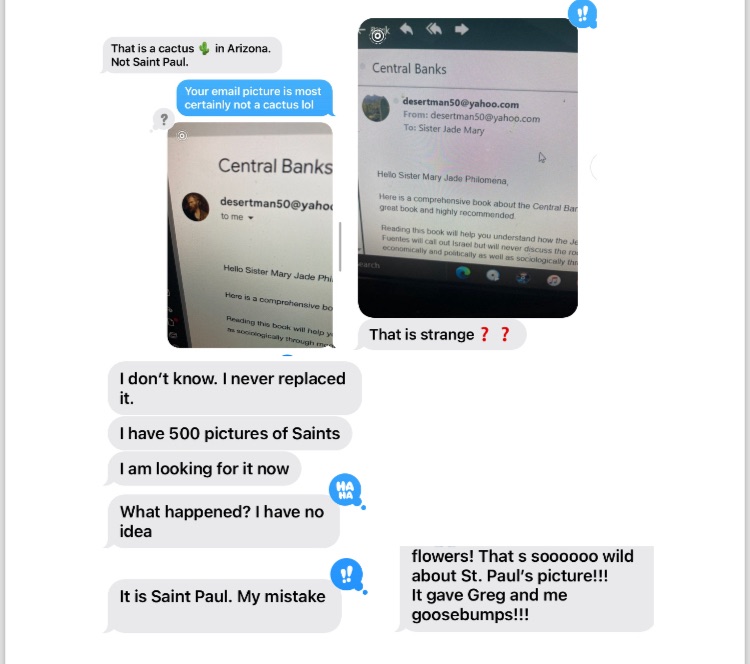
It takes a LOT for my Papa to get excited about “miracles” but even he couldn’t get over the story. Now that we are at long last reaching the conclusion, what was my own “aversion” to the Gentile Prince? Easy, when I read that he proclaimed it’s better to be “unmarried, like me” I immediately set myself up as his enemy, pre college drop out days. I was all caught up in that slavery that is feminism going to college and doing all those nonsensical masculine things. I’ll never forget my offense to his words of one can better serve God whole heartedly when fully devoted to Him in a life of full and complete celibacy/chastity. I do find it funny, in retrospect, how Protestants LOVE Saint Paul, yet it is he who more than any other apostle in my book, debunks their belief system (maybe there’s a mystery there, too with him playing a key role in their conversion with the triumph of Mary’s Heart?). They are modern day “gentiles” after all. Like the Jews, they reject the New Covenant. But like Paul, originally setting himself up as enemy of the Church, I likewise set myself up as his direct opponent SPECIFICALLY because of his stance on marriage. In fact, it wasn’t until I fully realized that it’s not that he is against earthly marriage per say (on the contrary, we see him telling husbands to love their wives THE WAY CHRIST DID THE CHURCH) but that he had his aim fixed on the “Marriage Supper of the Lamb” and it’s a complete pure, chaste and celibate kind of marriage.
Besides John the Baptist and John the Beloved, no one likely better understood this “divine intimacy” in this predestined “wedding” better than Paul. I caught my first real view of the fulfillment of Paul’s words when I dropped out of college on September 14th, feast of the Exaltation of the Cross, as I truly felt an unnecessary “weight” drop from my shoulders as Our Lord triumphed through His cross, when I dropped my “net”(er, classes) and experienced so deeply the interior joy of the “full and undivided” service to Christ Crucified, by becoming a “fool” for His sake. Best decision I have ever made, and I recommend this joyful path of service to anyone with a heart willing to serve. This heavenly Banquet hasn’t happened yet, but I believe we are getting close, and as “Best Man” Paul is called to be the “right hand man” to the bride on the DAY of the wedding and on the “lead up to it.” I often complain to those I love most that I just want to go to heaven. Those who, even though frail and weak, give their whole lives to God just want to be with Him and Mary and see Them face to Face already. We echo the heroic and humble words of little Francisco Marto when asked what he wanted to be when he grew up. He said, “I don’t want to be anything at all. I want to DIE and go to heaven.”
However, little by little I’m being reminded that it’s a pure blessing to LIVE in these times, because WE are called to prepare and pave the way for the Great Wedding predicted in the final book of scripture and if living means we get to be part of Mary’s triumph with Saint Paul, we must live this white martyrdom and maybe one day, it will prepare some of us for the red crown we so desire. Red martyrdom is a grace and is often only granted to those who have spent many years of training in enduring the white martyrdom: daily death to self and daily death to our own will. Even just the daily minor inconveniences and annoyances of life. The best really is saved for last, and as Our Lord said, The last will be first. Saint Paul is the best, and he’s saved for last. When Saint Paul was beheaded, he was heard to have said “Jesus, Jesus, Jesus” each time his head hit the ground to which three fountains miraculously formed there after his death. I don’t know about you, but even though this verse is so overused and typically by Protestants, they are powerful nonetheless and I still want Saint Paul’s words to truly mean something, and echo through my own death, when I draw my final breath:
I have fought a good fight, I have finished my course, I have kept the faith. As to the rest, there is laid up for me a crown of justice, which the Lord the just judge will render to me in that day: and not only to me, but to them also that love his coming. Make haste to come to me quickly.
2 Tim 4
 Carmelite Sister Martyrs