
~Laetare Sunday, March 15th, 2026~
Announcements:
Please consider donating to the hopeful future Sister Martyrs!
Buy from our shops:
Please know how incredibly grateful we are. We are still searching for a hopeful priest who can serve as our chaplain and father superior. We are not asking for much in regards to building giant monasteries. We desire only a simple two bedroom, two bathroom cabin, on or near the Latin Mass. God bless you!
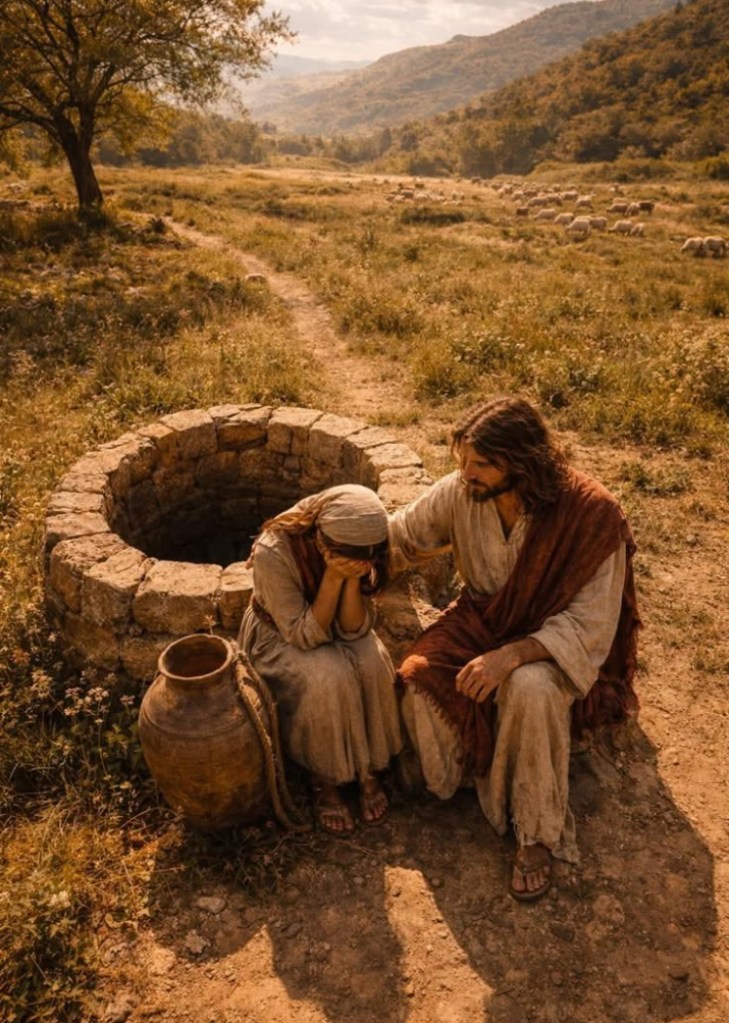
What is with the constant, and dare I say reoccurring theme, of “bondage” followed by “delivery”? Bondage. Delivery. Bondage. Delivery. “He loves me. He loves me not. HE LOVES ME.” Most of us are familiar with that flower picking analogy! Speaking of flowers… I don’t think it’s a coincidence that three of the most powerful, and mysterious, readings lead up to today’s “Rose Sunday.” Friday we had one of my all time favorites of the woman at the well where she is FREE to take of the “living water”, followed by Saturday’s Susanna being FALSELY accused of adultery then FREED by Daniel, and lastly today’s powerful readings in Matins: Our Lord appearing to Moses in the burning bush telling him that He has seen the affliction of His people in Egypt, and sends Moses to deliver them out of the hands of Pharaoh. Again, there’s a Constant pattern of “deliverance” and Our Lord acting as Bridegroom to rescue His damsel!
There are keys aspects we can learn from these Old and New Testament figures:
1.) Susanna, though falsely accused found herself “straightened on every side.” She knew it was only God and God alone who knew the truth and could deliver her. Father James Mawdsley made an unforgettable statement about what we can learn from her: “when we don’t know what to do, it’s enough to know what NOT to do.” I repeat that often!
2.) Our Lord sending Moses to free His people is a theme of the future wedding covenant as described by Brant Pitri in his book Jesus the Bridegroom. The Israelites couldn’t free themselves and so God sent them a “deliverer”. He sent them a shepherd. It’s not a coincidence Moses’ name means to “draw out”.
3.) Lastly, we have the beloved woman at the well! I am attaching Anne Emmerich’s vision of what SHE saw at the well, and while many things struck me, I’ll zero in on two things. She said the Garment Our Lord was wearing was when He intended to fulfill some type of prophecy etc. I pictured a wedding Garment! The second thing was the way Our Lord FOLLOWED the Samaritan woman to the well! Something about that just struck me as so mysterious and beautiful because here we have the GOD MAN THIRSTING after souls. He followed her?! Yeah, I’m excited.
I thought it fitting that on Gaudete Sunday I posted about Jacob’s well, and so today being Laetare Sunday, let’s bring this home with what Anne Emmerich saw at the well with Our Lord and the Samaritan woman. But first, recap: In my post on “Jesus’ Mysterious Betrothal at the Well”, I said:
This is where Pitre takes a rather Divine Turn in his studies of Jesus as Bridegroom and His mysterious meeting with the woman at the well:
Male Foreigner+Woman+Well=Betrothal.
Yes, you read that right. Remember when the apostles find Our Lord with the woman at the well in Samaria and they are, well, confused? We are led to think that this is because she is a Samaritan, perhaps. We know Our Lord cured and spoke with several women and so we know from scripture that Him conversing with women in general was not surprising. But here, it’s not the pharisees expressing wonder, but His apostles. Why is this? Because, not only was this JACOB’S well, but it was also a common meeting place of betrothals. Jacob met Rachel at that very well, his future wife, and Moses also met Sephora at a well.
BOTH Moses and Jacob were “foreigners” and so it did not take the apostles long to see Our Lord, as a “foreigner”, near not only a well, but JACOB’S well. This was a “green light” for betrothals, so to speak, and it did not go unnoticed by the apostles. I wish I could have been in Our Lord’s head at these encounters with His apostles as I am sure He knew they were often shocked at the God Man’s mysterious ways. Pitre even jokes and says even when the apostles can be rather “dense” at times, even they knew what speaking to a woman at a well meant. They knew these encounters often led to a wedding!
But why the Samaritan woman and what does she represent? The gentile bride, of course. And the Catholic Church? She is indeed the gentile bride. All over the Old Testament we read about what Brant Pitre calls “God’s estranged wife”, who, keeps turning away from Our Lord, and He patiently waits for her “return”.
Anne Emmerich’s Account:
Jacob’s Well
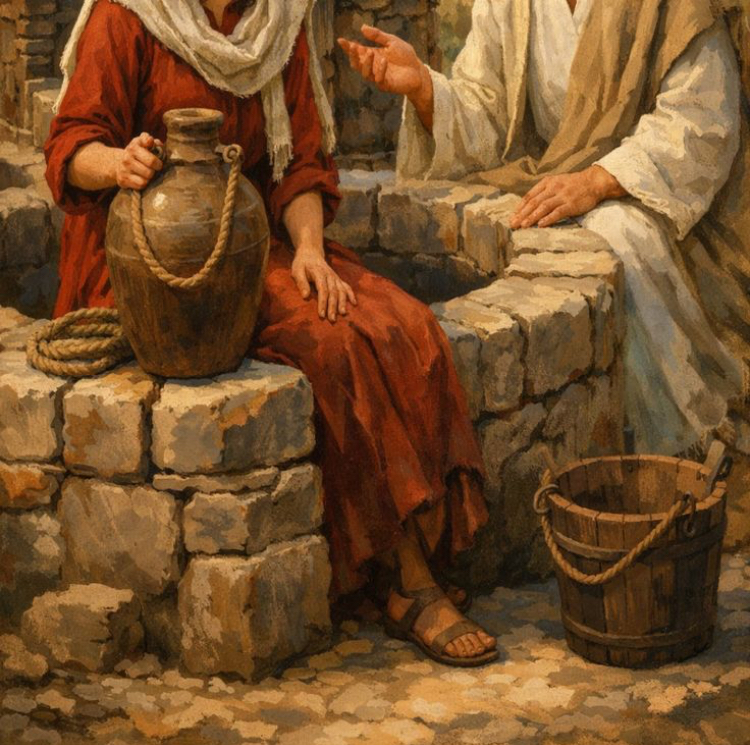
Opposite the door was a pump for raising the water to the top of the wall of the springhouse, whence it flowed out to the east, south, and west under the surrounding arches into three little basins dug in the earth. They were intended for travelers to perform their ablutions and wash their feet, also for watering beasts of burden.
It was toward midday when Jesus and the three disciples reached the hill. Jesus sent them on to Sichar to procure food, for He was hungry, while He Himself ascended the hill alone to await them. The day was hot, and Jesus was very tired and thirsty. He sat down a short distance from the well on the side of the path that led up from Sichar. Resting His head upon His hand, He seemed to be patiently waiting for someone to open the well and give Him to drink.
And now I saw a Samaritan woman of about thirty years, a leathern bottle hanging on her arm, coming up the hill from Sichar to draw water. She was beautiful, and I remarked how briskly and vigorously, and with what long strides she mounted the hill. Her costume appeared somewhat studied, and there was an air of distinction about it. Her dress was striped blue and red embroidered with large yellow flowers; the sleeves above and below the elbow were fastened by yellow bracelets, and were ruffled at the wrist. She wore a white stomacher ornamented with yellow cords.
Her neck was entirely concealed by a yellow woolen collar thickly covered with strings of pearl and coral. Her veil, very fine and long, was woven of some rich, woolen material. It hung down her back, but by means of a string could be drawn together and fastened around her waist. When thus worn, it formed a point behind and on either side folds in which the elbows could comfortably rest.
When both sides of the veil were fastened on the breast, the whole of the upper part of her person was enveloped as if in a mantle. Her head was bound with fillets that entirely concealed the hair. From her headdress there arose above the forehead something like a little tower or a crown. Tucked up behind it lay the forepart of the veil which, when let down over her face, reached to the breast.
She had her large, brownish goat or camel-hair apron with its open pockets, thrown up over her right arm, so that the leather bottle hanging on that arm was partly concealed. This apron was similar to those usually worn at such work as drawing water. It protected the dress from the bucket and water bottle. The bottle was of leather, and like a seamless sack. It was convex on two sides, as if lined with a firm, arched, wooden surface; but the two others, when the bottle was empty, lay together in folds like those of a pocketbook.
On the two firm sides were leather covered handles through which ran a leather strap used for carrying it on the arm. The mouth of the bottle was narrow. It could be opened like a funnel for receiving the contents, and closed again like a work pouch. When empty, the bottle hung flat on the side, but when filled it bulged out, holding as much as an ordinary water bucket.
It was under this guise that I saw the woman briskly ascending the hill, to get water from Jacob’s Well for herself and others. I took a fancy to her right away. She was so kind, so frank, so openhearted. She was called Dina, was the child of a mixed marriage, and belonged to the sect of Samaritans. She lived in Sichar, but it was not her birthplace. Her peculiar circumstances were unknown to the inhabitants, among whom she went by the name of Salome. Both she and her husband were very much liked on account of their open, friendly, and obliging manners.
The windings of the path by which she mounted the hill prevented Dina’s seeing the Lord until she actually stood before Him. There was something startling in the sight as He sat there exhausted and all alone on the path leading to Jacob’s Well. He wore a long, white robe of fine wool like an alb, bound with a broad girdle. It was a garment such as the Prophets wore, and which the disciples usually carried for Him. He made use of it only on solemn occasions when He preached, or fulfilled some Prophecy.
Dina coming thus suddenly upon Jesus was startled. She lowered her veil and hesitated to advance, for the Lord was sitting full in her path. I saw passing through her mind the characteristic thoughts: “A man! What is he doing here? Is it a temptation?” She saw that Jesus was a Jew as, beaming with benevolence, He graciously drew His feet back, for the path was narrow, with the words: “Pass on, and give Me to drink!”
These words touched the woman, since the Jews and the Samaritans were accustomed to exchange only glances of mutual aversion, and so she still lingered, saying: “Why art Thou here all alone at this hour? If anyone should happen to see me here with Thee, he would be scandalized.”
To which Jesus answered that His companions had gone on to the city to purchase food. Dina said: “Indeed! The three men whom I met? But they will find little at this hour. What the Sichemites have prepared for today, they need for themselves.” She spoke as if it were either a feast or a fast that day in Sichar, and named another place to which they should have gone for food.
But Jesus again said: “Pass on, and give Me to drink!” Then Dina passed by Him. Jesus arose and followed her to the well, which she unlocked. While going thither, she said: “How canst Thou, being a Jew, ask a drink from a Samaritan?” And Jesus answered her: “If thou didst know the gift of God and who He is that sayeth to thee: ‘Give Me to drink,’ thou wouldst perhaps have asked of Him, and He would have given thee living water.”
Then Dina loosened the cover and the bucket, meanwhile saying to Jesus, who had seated Himself on the rim of the well: “Sir, thou hast nothing wherein to draw, and the well is deep. Whence then hast Thou living water? Art thou greater than our father Jacob who gave us this well, and drank thereof himself and his children and his cattle?” As she uttered these words, I had a vision of Jacob’s digging the well and the water’s springing up.
The woman understood Jesus’ words to refer to the water of this well and so, as she was speaking, she put the bucket on the cylinder, which turned heavily, lowered it and drew it up again. She pushed up her sleeves with the bracelets until they puffed out high above the elbow, and in this way with bare arms she filled her leather bottle out of the bucket. Then, taking a little vessel made of bark and shaped like a horn, she filled it with water and handed it to Jesus, who sitting on the rim of the well drank it and said to her:
“Whosoever drinketh of this water, shall thirst again, but he that shall drink of the water that I shall give him, shall not thirst forever. Yes, the water that I will give him, shall become in him a fountain of water springing into life everlasting.”
Dina replied eagerly: “Sir, give me that living water, that I may no more thirst nor have to come with so much fatigue to draw.” She was struck by His words “living water” and had a presentiment, though without being fully conscious of it, that Jesus meant by the “living water” the fulfillment of the Promise. And so it was under prophetic inspiration that she uttered her heartfelt prayer for that living water.
I have always felt and understood that those persons with whom the Redeemer treated are not to be considered as mere individuals. They perfectly represented a whole race of people, and they did so, because they belonged to the plenitude of time. And so in Dina the Samaritan, there stood before the Redeemer the whole Samaritan sect, so long separated from the true faith of Israel, from the fountain of living water.
The Living Water
Jesus at the Well of Jacob thirsted after the chosen souls of Samaria, in order to refresh them with the living waters from which they had cut themselves off. It was that portion of the rebellious sect still open to salvation that here thirsted after this living water and, in a certain way, reached out an open hand to receive it. Samaria spoke through Dina: “Give me, O Lord, the Blessing of the Promise! Help me to obtain the living water from which I may receive more consolation than from this temporal Well of Jacob, through which alone we still have communication with the Jews.”
When Dina had thus spoken, Jesus said to her: “Go home, call thy husband, and come back hither!” and I heard Him give the command twice, because it was not to instruct her alone that He had come. In this command the Redeemer addressed the whole sect: “Samaria, call hither him to whom thou belongest, him who by a holy contract is lawfully bound to thee.” Dina replied to the Lord: “I have no husband!”
Samaria confessed to the Bridegroom of souls that she had no contract, that she belonged to no one. Jesus replied: “Thou hast said well, for thou hast had five husbands, and he with whom thou now livest is not thy husband. Thou hast spoken truly.” In these words the Messiah said to the sect: “Samaria, thou speakest the truth. Thou hast been espoused to the idols of five different nations, and thy present alliance with God is no marriage contract.” Here Dina, lowering her eyes and hanging her head, answered: “Sir, I see that Thou art a Prophet,” and she drew down her veil. The Samaritan sect recognized the divine mission of the Lord, and confessed its own guilt.
As if Dina understood the prophetic meaning of Jesus’ words: “and he with whom thou livest is not thy husband,” that is, thy actual connection with the true God is imperfect and illegal, the religion of the Samaritans has by sin and self-will been separated from God’s covenant with Jacob; as if she felt the deep significance of these words, she pointed toward the south, to the temple not far off on Mount Garizim, and said questioningly: “Our Fathers adored on that mountain, and you say that Jerusalem is the place where men must adore?”
Jesus replied with the words: “Woman! Believe Me, the hour cometh when neither in Garizim nor in Jerusalem wilt thou adore the Father.” In this reply He meant to say: “Samaria, the hour cometh when neither here nor in the sanctuary of the Temple will God be adored, because He walks in the midst of you,” and He continued: “You adore that which you know not, but we adore that which we know, for salvation is of the Jews.” Here He related to her a similitude of the wild, unfruitful suckers of trees, which shoot forth into wood and foliage, but produce no fruit.
It was as if He had said to the sect: “Samaria, thou hast not security in thy worship. Thou hast no union, no sacrament, no pledge of alliance, no Ark of the Covenant, no fruit. The Jews, from whom the Messiah will be born, have all these things, the Promise, and its fulfillment.”
And again Jesus said: “But the hour cometh and now is when the true adorers will adore the Father in spirit and in truth, for the Father wills such to adore Him. God is a spirit, and they that adore Him must adore Him in spirit, and in truth.” By these words the Redeemer meant: “Samaria, the hour cometh, yea, it now is, when the Father by true adorers will be honored in the Holy Ghost and in the Son, who is the Way and the Truth.” Dina replied: “I know that the Messiah cometh. When He is come, He will tell us all things.” In these words here at the Well of Jacob, spoke that portion of the Samaritan sect, which might lay some legitimate claim to the Promise: “I hope for, I believe in the coming of the Messiah. He will help us.” Jesus responded: “I am He, I who now speak to thee!”
Jesus Declares Himself the Messiah
By this He said to all Samaria that would be converted: “Samaria! I came to Jacob’s Well athirst for thee, thou water of this well. And when thou didst give Me to drink, I promised thee living water that would never let thee thirst again. And thou didst, hoping and believing, make known to Me thy longing for this water. Behold, I reward thee, for thou hast allayed My thirst after thee by thy desire after Me! Samaria, I am the Fountain of living water. I who now speak to thee, am the Messiah.”
As Jesus pronounced the words: “I am the Messiah,” Dina, trembling with holy joy, gazed at Him in amazement. But suddenly recovering herself, she turned and, leaving her water bottle standing and the well open, she fled down the hill to Sichar, to tell her husband and all whom she met what had happened to her. It was strictly forbidden to leave the Well of Jacob open, but what cared Dina now for the Well of Jacob! What cared she for her bucket of earthly water!
She had received the living water, and her loving, joyous heart was longing to pour its refreshing streams over all her neighbors. But as she was hurrying out of the springhouse, she ran past the three disciples who had come with the food and had already been standing for some time at a little distance from the door, wondering what their Master could have to say for so long with a Samaritan woman. But through reverence for Him, they fore bore to question.
Dina ran down to Sichar and with great eagerness said to her husband and others whom she met on the street: “Come up to Jacob’s Well! There you will see a man that has told me all the secret actions of my life. Come, He is certainly the Christ!’
Meanwhile the three disciples approached Jesus, who was still by the well, and offered Him some rolls and honey out of their basket, saying: “Master, eat!”
Jesus arose and left the well with the words: “I have meat to eat which you know not.” The disciples said to one another: “Hath any man brought Him to eat?” and they thought to themselves: “Did that Samaritan woman give Him to eat?” Jesus would not stop to eat, but began descending the hill to Sichar. The disciples followed, eating. Jesus said to them as He went on before: “My meat is to do the will of Him that sent Me, that I may perfect His work.” By that He meant, to convert the people of Sichar, after whose salvation His soul hungered. He spoke much more to the same purport.
When near the city, Dina the Samaritan again appeared hurrying back to meet Jesus. She joined Him respectfully, but full of joy and frankness, and Jesus addressed many words to her, sometimes standing still and sometimes moving slowly forward. He unfolded to her all her past life with all the dispositions of her soul. She was deeply moved and promised that both she and her husband would abandon all and follow Him. He pointed out to her many ways by which she could do penance for her sins and repair her scandals.
Dina was an intelligent woman of some standing in the world, the offspring of a mixed marriage, a Jewish mother and a pagan father, born upon a country seat near Damascus. She had lost her parents at an early age, and had been cared for by a dissolute nurse by whom her evil passions had been fostered. She had had five husbands one after another. Some had died of grief, others had been put out of the way by her new lovers. She had three daughters and two half-grown sons, all of whom had remained with the relatives of their respective fathers when their mother was obliged to leave Damascus.
Dina’s sons at a later period joined the seventy-two disciples. The man with whom she was now living was a relative of one of her former husbands. He was a rich merchant. As Dina followed the Samaritan religion, she had induced the man to remove to Sichar, where she superintended his household and lived with him, though without being espoused to him. They were looked upon in Sichar as a married couple. The husband was a vigorous man of about thirty-six years with a ruddy face and a reddish beard.
There were many things in Dina’s life similar to those of Magdalen’s, but she had fallen more deeply than the latter. Still I once saw that in the beginning of Magdalen’s evil career at Magdalum, one of her lovers lost his life at the hand of a rival. Dina was an uncommonly gifted, open-hearted, easily influenced, pleasing woman of great vivacity and impetuosity, but she was always disturbed in conscience. She was living now more respectably, that is with this her reputed husband, in a house that stood alone and surrounded by a moat, near the gate leading from Sichar to the spring house.
Though not held in contempt by the inhabitants, still they did not have much communication with her. Her manners were different from theirs, her costume elaborate and studied, all which, however, they pardoned in her as she was a stranger.
Dina’s People
While Jesus was speaking with Dina, the disciples followed at some distance, wondering what He could have to say to the woman. “We have brought Him food, and that with a good deal of difficulty. Why, now, does He not eat?”
When near Sichar, Dina left the Lord and hurried forward to meet her husband and many of the citizens, who came pouring out of their houses, all curiosity to see Jesus. Full of joy, they exulted and shouted salutations of welcome to Him. Jesus, standing still, motioned with His hand for silence, and addressed them kindly for some moments, telling them among other things to believe all that the woman had told them.
Jesus was so remarkably gracious in His words, His glance was so bright and penetrating that all hearts beat more quickly, all were borne toward Him, and they were instant in their solicitations for Him to enter and teach in their city. He promised that He would do so, but for the present passed on. This scene took place somewhere between three and four o’clock in the afternoon.
While Jesus was thus addressing the Samaritans outside the gate, all the other disciples, among them Peter, who in the morning had gone on commissions in a different direction, returned to their Master. They were surprised and not any too well pleased to see Him talking so long with the Samaritans. They felt somewhat embarrassed at it, for they had been reared in the preconceived idea that they were to have no communication with these people, consequently they had never before seen anything like this.
They felt tempted to take scandal at it. They reflected upon the hardships of yesterday and the day before, on all the scorn and insult, on the cruel treatment that they had endured. They had expected an easier time, since the women of Bethania had advanced so much money for that end. Seeing now this intercourse with the Samaritans, they thought to themselves it was certainly no wonder when things went on in this way that they were not better received. Their heads were always full of extravagant, worldly fancies of the Kingdom that Jesus was to establish, and they thought if all this should become known in Galilee, they would indeed be derided.
Peter had in Samaria a long conversation with that young man who wanted to join the disciples, but who was still wavering. He afterward spoke with Jesus on the subject.
Jesus went with them all about a half-hour around the city to the north, and there rested under some trees. On the way thither the Lord had been conversing with them about the harvest, a subject which He now continued. He said, “There is a proverb often on the lips, ‘yet four months, and the harvest cometh.’ Sluggards are ever desirous of putting off their work, but they should look around and see all the fields standing white for the harvest.”
Jesus meant the Samaritans and others who were ripe for conversion. “Ye, disciples, are called to the harvest, though ye have not sown. Others have sown, namely, the Prophets and John and I Myself. He that reapeth, receiveth wages and gathereth fruit for eternal life, that both He that soweth and he that reapeth may rejoice together. For in this is the saying true, that it is one man that soweth and it is another that reapeth. I have sent you to reap that in which you did not labor.
Others have labored and you have entered into their labors.” In this way Jesus spoke to the disciples in order to encourage them to the work. They rested only a short time and then separated, Andrew, Philip, Saturnin, and John remaining with Jesus, while the others went on to Galilee passing between Thebez and Samaria.
The Disciples
Jesus, leaving Sichar to the right, journeyed about an hour southward to a field around which were scattered twenty shepherd huts and tents. In one of the larger huts, the Blessed Virgin and Mary Cleophas, the wife of James the Greater, and two of the widows were awaiting Him. They had been there the whole day, having brought with them food and little flasks of balsam. They now prepared a meal. On meeting His Mother, Jesus extended both hands to her, while she inclined her head to Him. The women saluted Him by bowing their head and crossing their hands on their breast. There was a tree in front of the house, and under it they took the meal.
Among the shepherds dwelling around these parts were the parents of the youths whom Jesus, after the raising of Lazarus, took with Him on His journey to Arabia and Egypt. These people had come to Bethlehem in the suite of the three Holy Kings, had on account of the hasty departure of the latter remained behind in this country, and had married some of the shepherds’ daughters in the valley near Bethlehem. Shepherd settlements like that just mentioned were frequent in the winding valleys between this place and Bethlehem. The people dwelling here cultivated also the field of Joseph’s inheritance which they had rented from the Sichemites. There were many of them gathered here, but no Samaritans.
The first noteworthy incident that took place here was the Blessed Virgin’s begging Jesus to cure a lame boy whom some of the neighboring shepherds had brought thither. They had before doing so implored Mary’s intercession. Such things happened very often, and it was quite affecting to see her asking Jesus for these favors. Jesus commanded that the boy should be brought, and the parents bore him on a little litter to the door of the house in which Jesus was. The child was about nine years old.
Jesus addressed some words of exhortation to the parents and, as they fell back, somewhat timidly awaiting the result, the disciples gathered around Jesus. He spoke to the boy, leaned a little over him, then took him by the hand and raised him up. The boy jumped out of the litter, took a few steps, and then ran into the arms of his parents, who cast themselves with him at Jesus’ feet. The crowd uttered cries of joy, but Jesus reminded them to thank the Heavenly Father.
He then addressed a short instruction to the assembled shepherds and took with the disciples a light repast, which the women had prepared in an arbor under the great tree in front of the house. Mary and the women sat apart at the end of the table. I am under the impression that this house was taken for one of the private inns, and was prepared and served by the holy women of Capharnaum.
There approached now, and that rather timidly, several persons from Sichar, among them Dina, the woman of the well. They did not venture to draw near, because they were not accustomed to have intercourse with the Jewish shepherds. Dina, however, made bold to advance first, and I saw her talking with the women and the Blessed Virgin. After the repast, Jesus and the disciples took leave of the holy women, who immediately set about preparing for their return journey to Galilee whither Jesus Himself was to go the next day but one.
Jesus in Sichar
Jesus now returned with Dina and the other Samaritans to Sichar, a city not very large, but with broad streets and open squares. The Samaritan house of prayer was a finer looking building, more ornamented than the synagogues of small Jewish places. The women of Sichar were not so reserved as the Jewish women; they communicated more freely with the men. As soon as Jesus entered Sichar, He was surrounded by a crowd. He did not go into their synagogue, but taught walking around here and there on the streets, and in one of the squares where there was an orator’s chair. Everywhere was the concourse of people very great, and they were full of joy at the Messiah’s having come to them.
Dina, though very much moved and very recollected, was of all the women the one that approached nearest to Jesus. Her neighbors now looked upon her with special regard, as she had been the first to find Jesus. She sent the man with whom she was living to Jesus, who spoke to him a few words of exhortation. He stood before Jesus quite embarrassed, and ashamed of his sins. Jesus did not tarry long in Sichar, but went out by the opposite gate and taught here and there among the houses and gardens that extended for some distance along the valley. He put up at an inn distant from Sichar a good half-hour, promising, however, to return to the city on the following day and give them an instruction.
When Jesus went again to Sichar, He taught the whole day, dividing the time between the orator’s chair in the city and the hills outside, and in the evening He taught again in the inn. From the whole country around came crowds to hear Him, and they followed Him from place to place. The cry was: “Now He is teaching here! Now He is teaching there!” The young man of Samaria also listened to the instructions, but he did not speak with Jesus.
Dina was everywhere foremost, everywhere made her way through the crowd to Jesus. She was very attentive, very earnest, and deeply impressed. She had had another interview with Jesus and was now about to separate from her reputed husband. They had resolved for Jesus’ sake to consecrate all their riches to the poor and the good of the future Church, Jesus told them how to proceed in the affair. Many of the Samaritans were profoundly touched by what they had seen and heard, and they said to Dina: “Thou hast spoken truly. We have now heard Him ourselves. He is the Messiah!” The good woman was quite out of herself, and so in earnest, so joyous! I have always loved her dearly.
Here as in former places, Jesus took for the subjects of His discourse: the imprisonment of John, the persecution of the Prophets, the Precursor charged to prepare the ways, and the son sent to the vineyard, but who was murdered by the wicked servants. He declared plainly that the Father had sent Him. He taught also upon all that He had said to the woman at the well, namely, the living water, Mount Garizim, salvation from the Jews, the nearness of the Kingdom and the Judgment, and the punishment inflicted upon the wicked servants who had put to death the son of the lord of the vineyard.
Many of His hearers questioned Him as to where now they should be baptized and cleansed, since John was imprisoned. Jesus answered that John’s disciples were again baptizing near Ennon across the Jordan, and that, until He Himself should appear there with His disciples to give Baptism, they should go thither. On the following day, accordingly, crowds flocked to Ennon.
Next day Jesus taught at the inn and on the surrounding hills. His audience consisted of laborers, of all kinds of people, and those slaves whom, after His baptism, He had once consoled in the field of the shepherds near Bethabara. There were present also many spies sent by the Pharisees from the environs around. They listened to Him with anger in their hearts, stuck their heads together, and muttered jeeringly. But they did not attempt to accost Him, and He took no notice of them. Several Samaritan Doctors and others remained unmoved by His words, receiving them into a disaffected heart.
~End of Anne Emmerich~
Ave Maria, Christ is King!
News:
Something important to note which adds into the below news about what’s currently going on in Iran, is what Our Lord told the woman at the well. He told her that the hour was approaching that they would no longer worship in the Jerusalem Temple. Remember the Jews could only offer blood sacrifice in that particular spot and they traveled to get there. Our Lord, being the last blood sacrifice as LAMB ended that form of blood sacrifice along with the Jewish Levitical priesthood, and founded the NEW covenant of promise (just as we read today in the Epistle of Saint Paul). Our Lord Himself became the LIVING temple and now with the Church being universal, we have an unbloody sacrifice on the altar offered daily in “remembrance” of Our Lord’s ultimate self offering.
THIS is why the Jews are so hell bent (literally- summoning demons and acting demonic) by desiring to rebuild the 3rd temple. But according to Church Fathers, it will never be rebuilt. 1.) Because Christ HIMSELF is the 3rd Temple and 2.) as Father Ripperger just reminded the flock, the prophecy of Daniel applies to the Catholic Church, not the Jews. Where does Iran fit in to all of this? 1948 “Israël” is focused on “greater Israel” and their belief of scripture and prophecy is very linked to ancient Persia (Iran). It’s very important that we as Catholics educate ourselves on what the Church teaches through PROPER interpretation of Sacred Scripture, and to be wise as serpents and simple as doves when it comes to the Jews. I highly recommend the below videos that include Iran’s REAL history of what America has done to them going back to 1953 we when overthrew their democratically elected leader because he “dared” claim ownership to the oil on THEIR LAND.
I’m not saying I’m pro Muslim, now. No. Not at all. I whole heartedly desire Muslims to convert to Catholicism. But what I am saying is history tells a very different story and when you know that TRUE story, you can no longer say that Iran is the “bully in the Middle East.” We, America and 1948 “Israel” are the true bullies and they are doing what’s called “projection”. You see, I’m all too familiar with narcissism (spirit of Babylon) and can tell you bluntly that America and “Israel” are and will go through something commonly known as “narcissistic collapse.” They will be utterly humiliated and punished for their crimes against humanity.
When it comes to true journalism I tune into people like Judge Andrew Napolitano, who brings on great guests like Professor Jeffrey Sachs, and former military commanders who know first hand what’s true or false narratives. Charlie Kirk was also vehemently apposed to war and regime change in Iran, and if he’s not alive somewhere, this is certainly why Israel and America had him killed:

You know the saying, “it’s dangerous to be enemies with America. It’s FATAL to be friends with America.” People in Iran have stated that while their government isn’t ideal, they DO NOT want to be controlled by America because they know what we do behind closed doors. Like the woman of Samaria representing her people’s sin. America’s sin is being exposed, and only when Russia is finally consecrated to Mary, will there be true peace and harmony among nations. Not Donald Trump’s or Bibi Satanyahoo’s version of “peace”.
Trump was installed and Father Kramer’s predictions:
I believe the sign in the sky (mentioned in the Third Secret), that will accompany the illumination of conscience might even happen this month — possibly around St. Patrick’s Day. The world war is imminent. The Chinese Communists have given Iran hypersonic missiles that can sink aircraft carriers. The American carriers have moved back out of range of those missiles — placing the carrier’s planes out of range of Iranian targets. Israel is getting devastated by Iranian missile strikes. Israel is losing the war so far. The “doomsday planes” have been deployed — which mesns Trump might even nuke Iran. The situation is now out of control for the US, but Trump talks like a madman, saying the war is already won.
THE DIFFERENCE BETWEEN STARMER AND TRUMP IS THAT STARMER IS A TYRANT WORKING FOR EVIL — TRUMP IS A DEVIL APPEARING AS AN ANGEL OF LIGHT — BUT BOTH ARE TYRANTS. BOTH DOUBLE DOWN WITH THEIR TYRANNY, APPEARING TO BE AT OPPOSITE ENDS OF THE POLITICAL SPECTRUM — BUT THEY ARE UNITED IN THEIR WILL TO STAMP OUT THE RIGHTS OF THE PEOPLE AND SERVE THE INTERESTS OF THE SONS OF DARKNESS.
I thought Trump would be the lesser evil than Harris, until I saw Trump implementing the same game plan as Adolf Hitler in the 30s and Ferdinand Marcos in the early 70s — then I realized that TRUMP IS THE CLOSER. That’s why he was chosen over Harris. He is as tight with Soros and his globalist ilk as any Democrat has ever been. TRUMP WAS DESIGNATED TO BE THE DEMOCRATICALLY ELECTED PRESIDENT WHO WILL SUPPRESS CONSTITUTIONAL RULE, AND REPLACE IT WITH A MARTIAL LAW DICTATORSHIP. Then, Trump will be shunted aside and then it’s time for THE GREAT RESET.
The immigration enforcement operations are a smoke screen that conditions the population to become accustomed to seeing military troops in the streets, and conditions them to accept the new status quo: the people are being stripped of their right to due process, and now are faced with immediate arrest by brutal stormtroopers without probable cause or warrant, with the option either of total compliance or being shot on the spot. IMMIGRATION ENFORCEMENT WILL BE FOLLOWED BY STALINESQUE PURGES. The American GULAG has already been built and is beginning to become operational. Millions of Americans will be exterminated in these death camps.
JFK was taken out so that a more compliant successor would lay the new foundation for the New World Order. Johnson, Nixon, Ford, Reagan were the table setters who appointed globalists in their cabinet and in the expanded federal bureaucracy — then Bush openly announced the plan “a big idea — a New World Order.” Clinton, Bush II, Obama and Biden accelerated the implementation of Socialism — and finally — TRUMP presides over the suppression of the constitutional republic, and its replacement — first with his own strongman dictatorship, and then the post Trump regime will be a PROC style Communist bureaucratic dictatorship — but it won’t be called Communist. It will not be atheist, but it will be perversely godless, with a horribly intolerant counterfeit religion that will ferociously persecute true Catholics, as well as Protestants who won’t comply with their degenerate pseudo religion. THE BIG CORPORATIONS WILL OWN ALL PROPERTY. YOU WILL BE HERDED INTO PRISON LIKE ACCOMODATIONS. YOU WILL BE GIVEN DRUGS TO MAKE YOU FEEL HAPPY. “YOU WILL OWN NOTHING BUT YOU WILL BE HAPPY.”
If you think I’m dreaming, then READ MY BOOK: The Mystery of Iniquity. Look at the BIBLIOGRAPHY at the end of the volume. It is all documented — a conspiracy as real as the conspiracy of Robespierre and the Jacobins, Hitler and the Nazis, Lenin and the Bolsheviks — ALL OF THEM APPROVED AND BACKED BY THE SUPREME COUNCILS OF JUDEO-MASONRY.
 Carmelite Sister Martyrs